Local Rules
An Inch and a Half. That Is the Whole Rule.
It is one of the tightest branch limits you will find anywhere, and it decides most tree jobs in this city before they start.
The number that decides it
Quincy's yard waste service runs through a City contractor, and the single most useful thing to know about it is a measurement.
An inch and a half is not much. It is a broom handle, roughly. Most of what comes off a mature tree in this city is thicker than that before you are more than a few feet in from the tip.
The practical instruction from the City is simple: if you have something bigger, break it or cut it so it is smaller in length — and if it is too thick, it is not going curbside at all.
The stripe on the bag
Leaves and loose garden material have their own presentation requirement, and it is unusually specific.
Leaves must be in a container, or in a yard waste bag with a stripe all the way around.
The stripe is the point. It is what tells a crew at a glance that a bag is yard waste rather than household garbage, from any angle, without opening it. A bag without the stripe is ambiguous, and ambiguous material does not get collected.
So: buy the marked bags, and do not decant leaves into whatever sacks are in the garage.
⚠️ Fifty pounds, and no drums
Two limits that come as a pair, and both catch people out.
- Nothing over 50 pounds.
- Nothing in a drum-size container.
The drum rule exists because of the weight rule. A 55-gallon drum full of wet leaves is far past what anyone can lift, and once it is at the curb it is somebody's back. Ruling out the container rules out the problem.
Fifty pounds arrives faster than people expect:
- Wet leaves and grass after rain. The same bag can double overnight.
- Green limbs, which are full of water and much heavier than seasoned wood.
- Root balls with soil attached. Soil is the heaviest thing in any garden — shake it out.
- Anything that has sat out through a wet week.
If a bag splits when the crew lifts it, that is a bag that does not get collected — and now it is loose material in the street, which is a separate problem.
Sticks must be bundled or in a can
Loose sticks are not collected. They have to be either bundled together or in a can.
The reason is the same as everywhere else in this system: a crew working a route needs to lift a defined object, not gather an armful of scattered material off a verge. Bundling is the difference between one lift and five minutes of tidying.
Practical advice, and it saves real time: cut and bundle as you prune. A branch cut to length and added to a tied bundle while you are already holding it takes seconds. The same branch dragged to the curb, dropped on a pile and buried under everything else has to be handled twice.
Why the limits are this tight
Yard waste is collected because it has an onward use — it is organic material that can be composted or processed rather than buried. That processing is what sets the limits.
Material has to go through equipment that has a physical capacity. Oversized wood does not fit it, and overweight bags cannot be handled safely by the people loading them. The rules are not bureaucratic caution; they are the specification of the machinery and the crew.
The same logic explains why the streams have to stay separate. Once yard waste is contaminated with household garbage or treated timber, the whole load becomes waste rather than compost and the onward route is lost. That matters to us too: a clean load of brush in a container has a cheaper route than the same brush with fence panels mixed in.
What is not yard waste at all
Several things that come out of a garden are not yard waste, and putting them in that stream contaminates it:
- Treated timber. Fence posts, deck boards, landscape ties, raised beds. In this climate essentially all exterior wood is treated.
- Fence panels and hardware, painted or not.
- Soil, sod and rock. Heavy, and not garden refuse in the sense intended.
- Pots, trays and irrigation pipe.
- Concrete edging, pavers and retaining blocks.
- Stumps, which are past every limit on the list at once.
- Trunk sections and split rounds, for the same reason.
A landscape rebuild almost always produces a mixture of all of these, which is why the whole job usually wants a container rather than an attempt to split it across streams.
Where tree work goes instead
Given a one-and-a-half-inch limit, almost any real tree job needs another route.
What that means in practice:
- A tree down. The brush at the tips might go curbside if it is bundled and light enough. Everything from the first fork inwards does not.
- Storm damage, which arrives all at once and is mostly limbs well over the limit.
- Whole-garden clearance on a property that has been let go.
- Landscape rebuilds, which mix green waste with timber, soil and hardscape.
- Acreage work out toward Camp Point, Golden and Clayton, where there is simply more of everything.
Ask your arborist what they take away as part of the job — many will haul the wood, and that is usually the cheapest answer for the large material. What is left is the brush and the debris, and that is a container.
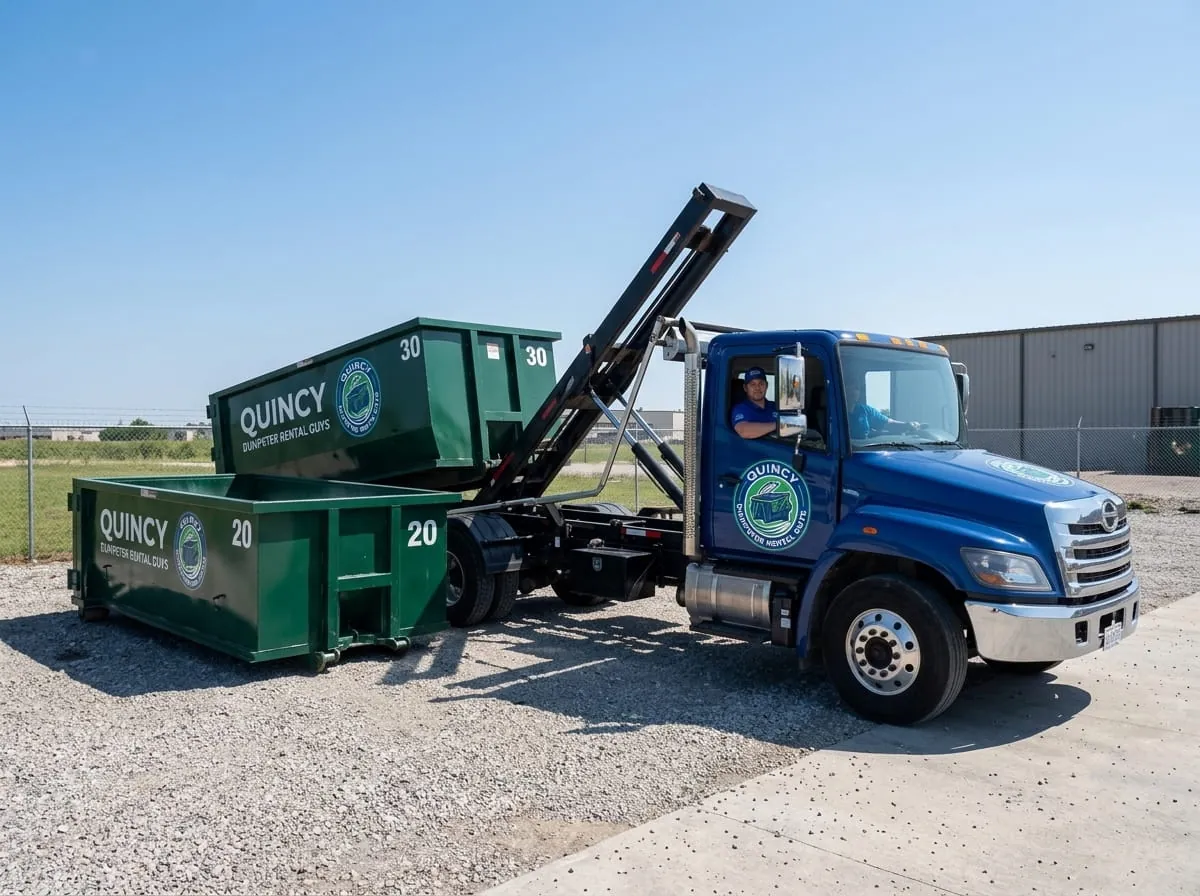
If you book a container for green waste, keep it clean and tell us that is what it is. Clean brush and prunings have their own route; the same load with treated timber in it does not.
A pre-collection checklist
- Sticks no thicker than about 1.5 inches and no longer than about 4 to 5 feet
- Sticks bundled or in a can — never loose
- Leaves in a container or a yard waste bag with a stripe all the way around
- Nothing over 50 pounds — check the wet bags especially
- No drum-size containers, at all
- Shake the soil off root balls
- Treated timber out of the yard waste entirely
- Fence panels, pots and pavers out — they are not yard waste
- Cut and bundle as you prune, not afterwards
- Anything past the limits: ask the arborist, or book a container
Collection arrangements, contractors and limits change. Everything above reflects the City of Quincy's published arrangements and its contractor's stated requirements at the time of writing, and applies inside the city limits only. Confirm current details with Central Services on (217) 228-4500.
Need a container in Quincy?
Call and describe the job. Three minutes on the phone gets you a size recommendation, a flat rate and a delivery window — and we will tell you if a smaller, cheaper container is the right answer.
Call (217) 919-5126